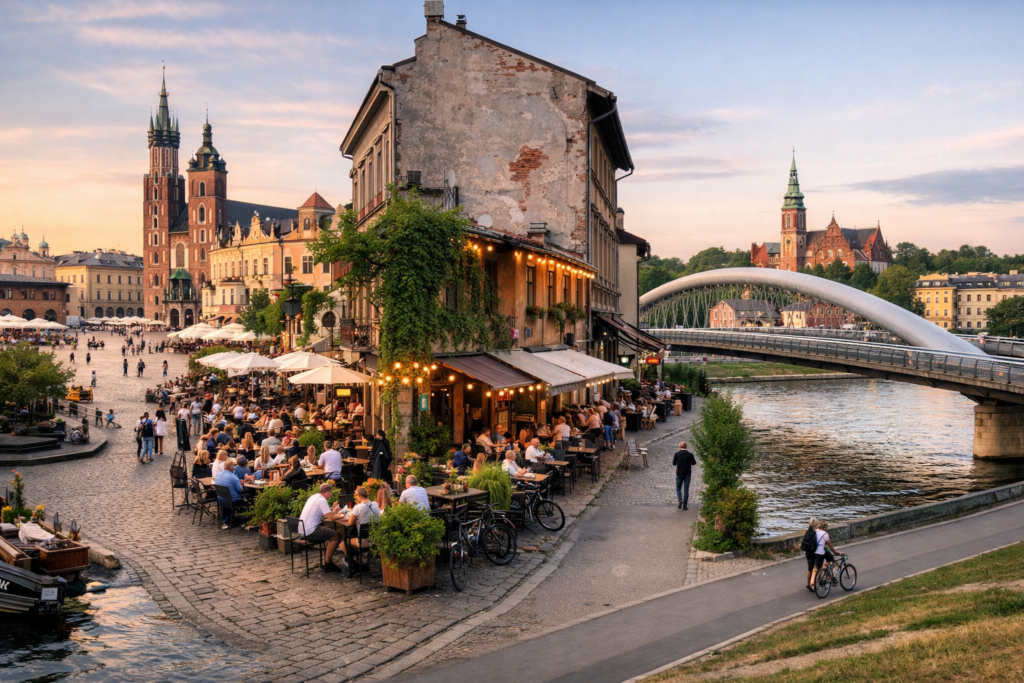
Zabłocie Krakow is one of the city’s most visibly changing urban areas: former factories, railway land and riverside infrastructure now sit beside museums, contemporary art, public spaces and new walking and cycling connections. It is a useful area to explore when you want more than Krakow’s historic centre, especially if your interests include modern history, architecture, public space and the changing relationship between the city and the Vistula.
The most important point is that Zabłocie is not a separate administrative district of Krakow. It is a commonly used neighbourhood name within Dzielnica XIII Podgórze. The name also appears in the formal local spatial plan adopted in 2006, but the plan’s boundaries should not be treated as an exact outline of the neighbourhood understood in everyday conversation.
What kind of area is Zabłocie?
Zabłocie developed around industry, warehouses, railway functions and access to the Vistula. That history is still visible in the scale of industrial buildings, the mixture of older structures and newer developments, and the way roads and open spaces divide the area. At the same time, the former industrial setting has gained new cultural and public functions.
This layered character is what makes Zabłocie different from a conventional sightseeing district. A museum visit can lead into a walk through former industrial streets; a riverside route can continue towards Podgórze; and a contemporary art institution occupies the same wider complex as a museum focused on the wartime history of Krakow. The area is best understood as a neighbourhood in transition, rather than as a finished redevelopment project.
Which museums should you visit in Zabłocie?
Fabryka Emalia Oskara Schindlera
The exhibition focuses on Krakow under German occupation and places individual stories within the wider history of the city during the Second World War. It is therefore one of the strongest reasons to include Zabłocie in a Krakow itinerary, particularly for visitors who want historical context rather than only architectural photographs.
Opening arrangements are currently listed as Mondays from 10:00 to 15:00 and Tuesday to Sunday from 9:00 to 20:00, with last entry 1.5 hours before closing. The number of tickets is limited, so checking the museum’s current information before travelling is sensible. For named online tickets, visitors may also need an identity document.
MOCAK – Museum of Contemporary Art in Krakow
MOCAK – Museum of Contemporary Art in Krakow is also at ul. Lipowa 4, but it is a separate institution from Fabryka Emalia Oskara Schindlera. The shared address makes it easy to combine the two, while their subjects are very different: one deals with the wartime history of Krakow and the other represents the contemporary artistic layer of the former industrial area.
This pairing explains much about Zabłocie’s transformation. The industrial setting has not simply been cleared and replaced with a new neighbourhood. Instead, existing buildings and sites have acquired cultural roles, allowing historical memory, modern art and post-industrial architecture to be experienced within the same part of the city.
How has Zabłocie changed around the Vistula?
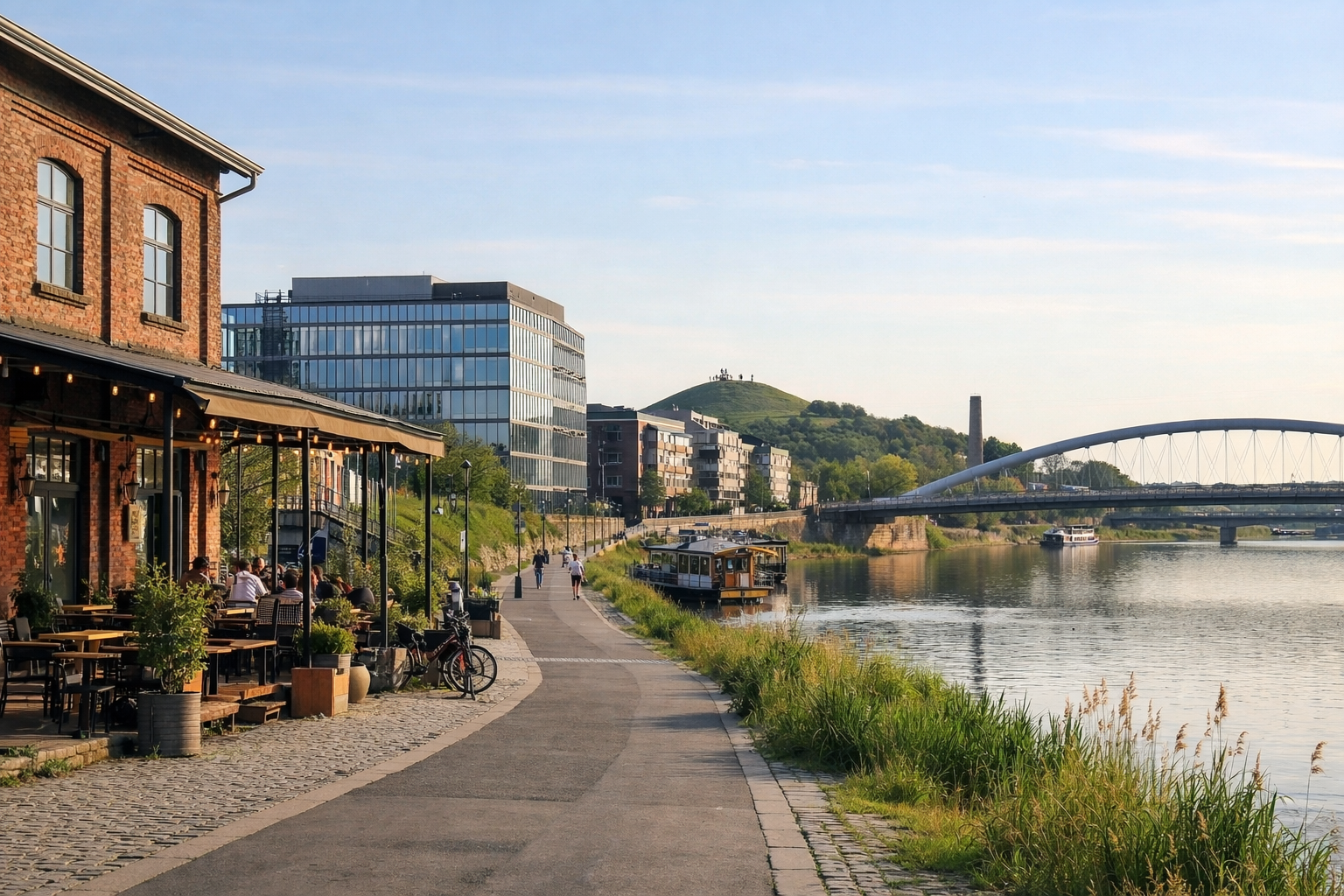
The riverside is central to understanding the area’s current direction. The Grzegórzki-Zabłocie foot and cycle bridge has connected Zabłocie with Grzegórzki and Kazimierz since 10 June 2023. It is a practical crossing as well as a visible sign that the Vistula is becoming a stronger part of everyday movement through Krakow.
The bridge should be viewed as one connection within a wider network, not as a description of the entire riverbank. Routes and access points can change during nearby construction and public-space works, so it is better to use the bridge as a clear orientation point while checking the exact route on the day of a walk.
Park Stacja Wisła
Park Stacja Wisła is located around ul. Zabłocie and Bulwar Lotników Alianckich. It is a public green space developed on land associated with the former Krakow-Wisła goods station. The park shows how railway and industrial land can gain a new civic function without losing all connection to its previous identity.
The park’s expansion formed a separate 2026 project involving elements such as paths, lighting, small architecture and planting. The entire expansion should not be described as completed. For visitors, the useful distinction is between the existing public park and the wider programme of improvements and enlargement still being developed.
Open the related LiveKrakow guide and compare more options.
What is the new Park Kolejowy connection?
The third stage of Park Kolejowy was opened to users on 18 May 2026. It provides a walking and cycling route from the area of the Vistula bridge through Zabłocie and Podgórze towards ul. Powstańców Wielkopolskich. This is one of the most important recent changes for exploring the neighbourhood without treating it as a collection of isolated destinations.
On a map, the route can be understood as a linear connection: the bridge area, Zabłocie, Podgórze and the direction of ul. Powstańców Wielkopolskich are linked by a public path. Its importance is practical as well as symbolic. Former railway land becomes part of a route used for everyday movement, leisure and access to the river, while the area’s transport history remains part of the landscape.
The new section also changes how visitors can plan their time. Instead of visiting Lipowa Street and returning by the same route, you can combine the museums with a longer walk towards the riverside and Podgórze. Exact access conditions may vary around ongoing works, but the third stage is an available connection rather than a future proposal.
How should you plan a visit to Zabłocie?
Begin at ul. Lipowa 4 if museums are your priority. Fabryka Emalia Oskara Schindlera and MOCAK are separate institutions, so allow time for each rather than treating the address as one attraction. The former factory is the stronger choice for visitors focused on Krakow during the occupation, while MOCAK provides a contrasting contemporary perspective.
After the museum area, continue towards the Vistula and Park Stacja Wisła. This shift from enclosed cultural venues to open public space makes the area’s transformation easier to read. Former railway land, riverside infrastructure and new planting are encountered alongside newer urban development rather than behind a single preserved historic façade.
If you are approaching from Kazimierz or Grzegórzki, the Grzegórzki-Zabłocie bridge is the key pedestrian and cycling connection. From the bridge area, the third stage of Park Kolejowy provides a route through Zabłocie and onwards towards Podgórze. These links make Zabłocie suitable for a broader walk through the southern and central parts of Krakow.
- For history: choose Fabryka Emalia Oskara Schindlera and read Zabłocie through its wartime and industrial past.
- For contemporary culture: combine the same Lipowa 4 complex with MOCAK, a separate museum with a different purpose.
- For public space: include Park Stacja Wisła and the riverside area, remembering that its enlargement is a continuing process.
- For walking and cycling: use the Grzegórzki-Zabłocie bridge and the opened third stage of Park Kolejowy as orientation points.
Is Zabłocie worth visiting?
Yes, especially if you want to see how Krakow is changing beyond the Old Town and Kazimierz. Zabłocie brings together two powerful museum destinations, an industrial and railway landscape, contemporary art, riverside greenery and new pedestrian and cycling infrastructure. Its appeal is not based on one uniform architectural style. It comes from the contrast between what remains, what has been adapted and what is still being developed.
The area also works well for visitors interested in food and a more contemporary city atmosphere, although its dining offer should be treated as part of a changing mixed-use neighbourhood rather than as a fixed list of established landmarks. The most dependable reasons to come are the museums, the riverside spaces and the ability to connect Zabłocie with Grzegórzki, Kazimierz and Podgórze on foot or by bicycle.
In short, Zabłocie Krakow is best visited as a layered urban area: start with history at Lipowa 4, add contemporary art, walk through the former railway landscape, and finish by the Vistula. That sequence reveals the neighbourhood’s central story – industrial and railway traces have not disappeared, but have been joined by cultural institutions, public greenery and new ways of moving through the city.